Tuesday, January 21, 2020

Pre-Vis Lesson 2 - Distance/ Tracking Shots and Camera Coverage


  In todays Maya lesson, we are carrying on with pre-visualization. In the distance shots, we worked on 3 different styles, the first being close up and the second two being more at a distance. These shots was created in Maya, and each camera has a different Pan, Translate X and Height setting for the keyframes required. It seems some of the shots have the wireframe still present, a small oversight that can be corrected easily.

  Distance Coverage Shots

    These shots was done with Dolly cameras.

Close Up Shot plus Pan


Mid-Shot plus Pan


Wide-Shot with a Pan


  Camera Coverage Shot

  Continuing on with the final shots, the car filmed using several cameras and then placed into Adobe Premier, here we created our final visualisation. I have managed to upload one version, but it will not let me up load the others.


Monday, January 20, 2020

From Script to Screen - Main Character Concept and Profile


   I've fleshed out more about the main character, and done a more finalised version of his design. The final art was quite fun to do, and is painted in Photoshop. I'm learning more and more in digital painting. Next will be final concepts of the dog, sword and some and some environment paintings of the theatre. Blogger does seem to alter the colours a small amount when uploaded, but there isn't much difference. I've done the more traditional colours for the clothing. I've kept to a more lined and cell shaded style as I understand this, but would like to start branching out into different methods.


Name: William Johnson
Nickname: Bill
Born: 1907
Age: 68
Height: 6'1
Hair: Greying
Eye Colour: Blue
Personality: Kind and easy going, although slightly clumsy. 
Likes to tell a story.
Relationship: Widowed


Background: Bill was born in London in 1907, living in a small house with his parents and 3 brothers. Growing up, Bill had a love for taking things apart and figuring out how they worked. At 13, Bill started a apprentice job as a builder, but growing bored he decided to join the Army at 15. Here, Bill decided to learn Bomb Disposal. WW2 started against Germany in 1939, meaning Bill was to join in the front lines. At 34, Bill got injured in trying to deactivate a live bomb, managing to run but no far enough and his leg got injured in the detonation. Returning back to England, once he had recovered, Bill started working in one of the 6 companies around London deposing of undetonated bombs. 

After WW2 had ended, Bill recieve a honor and stayed on at the Army to teach Bomb Disposal, till he retired at 57. However, Bill's wife sadly passed not long after, and having no children, it meant Bill was living alone. Bill was not lonely as he has gained many friends over his years, and often would go to the local shops and theatre, telling stories of his adventures. One evening when visiting the theatre, he overhears that the janitor has left. Bill being quite a jack of all trades, offered to work for a short while until they find a replacement, bringing us to his first night on the job. 


      Research 

     During World War 2, England suffered large scales aerial attacks from German air forces, mainly unitised towards populated cities such as London and Liverpool. In the events of these invasions, multitudes of bombs would be dropped. however, due to the quick production process and faulty mechanics, many did not detonate on contact or was considered "Duds".  In May 1940, the Foundation of Order was released to create 25 bomb disposal sections to work around London. It quickly became clear that 25 sections would not be enough to cope, so another 109 was authorized.The withdrawal of troops from the front lines was not possible as their expertise was needed there, so the calling for volunteers meant that many young officers stepped forward, and they hadn't long left the OCTU (Officer Cadet Training Unit).

    Equipment was deemed low on the grounds, so to dig down to the bombs, pieces of corrugated iron and debris from houses was used.  In the actual de-fuzing of the bombs, the appointed officer would use a hammer and chisel to unscrew the locking ring, gently withdrawing the fuse and rolling the bomb to release the picrics from the fuze pocket. By the end of August 1940, new bomb fuzing and a huge increase of attacks from the Luftwaffe meant an increase of deaths and casualties, the young recruits was poorly trained an struggled in the demand, so better organization was agreed. In the time between September 1940 and July 1941, 25 new sections had been created and trained, meaning 24,108 unexploded bombs was deactivated and removed. Each new section would control and command specific parts of london, sections was also deployed to Newcastle, Edinburgh, Leeds and Nottingham.

Friday, January 17, 2020

From Script to Screen - "Like-for-Like" Storyboard


   Following the workshop today for storyboarding, the third and final task was to create a "like-for-like" storyboard. This requires choosing a scene that is at least 2 minutes long from a film/animation/ advert. With this piece, we would then recreate how a director would want a storyboard to be created from an storyboard artist, then proceeding to create their image  We have to think about making the pictures clear with plenty of information, numbering the main shots, understand what type of camera shots would be best and adding written information about what is happening.

  For my "Like-to-Like", I chose the final fight scene from Kung Fu Panda 2. These animated features have plenty of fast action scenes, and these require much more shots then one with just a conversation. I also decided to work in pencil. Pencil gives me a much better workflow for gaining emotions and information, allowing me to start light and increase density to bring more impact. For the frame sizes, the film is in the ratio of  2.35:1 then 16:9 for blu-ray, so a wide width frame is best. The final fight is the 10th scene in the film, I also placed what time each shot happened so to gain a better understand of shot pace.  The shot is also to go through the frames, as the world doesn't stop at lines, and makes for a much better storyboard. I'm hoping I managed to get all the camera angles right.

  The beginning of the scene is a conversation between Po and Shen after having his fleet blown up, Shen at this point is baffled and bewildered, unbelieving in his defeat. Po tries to comfort him in the hope to help him let go of his hatred, However Shen decides to attack in a fit of anger, eventually leading to his downfall.

  Further though the shots, once Po and Shen start fighting, I placed coloured arrows to show the direction the would take. Po is the Green arrows, and Shen is the Red. At the start I placed She as "bad guy" and Po as "hero", but deemed it better to use their names as the scene moved on.


Sheet 1

Sheet 2

Sheet 3

Sheet 4

Sheet 5

Sheet 6

Sheet 7

Sheet 8

Sheet 9

Sheet 10

Monkey, Tigress and Viper appear in the 40th shot.

Sheet 12


From Script to Screen - Scene Workshop

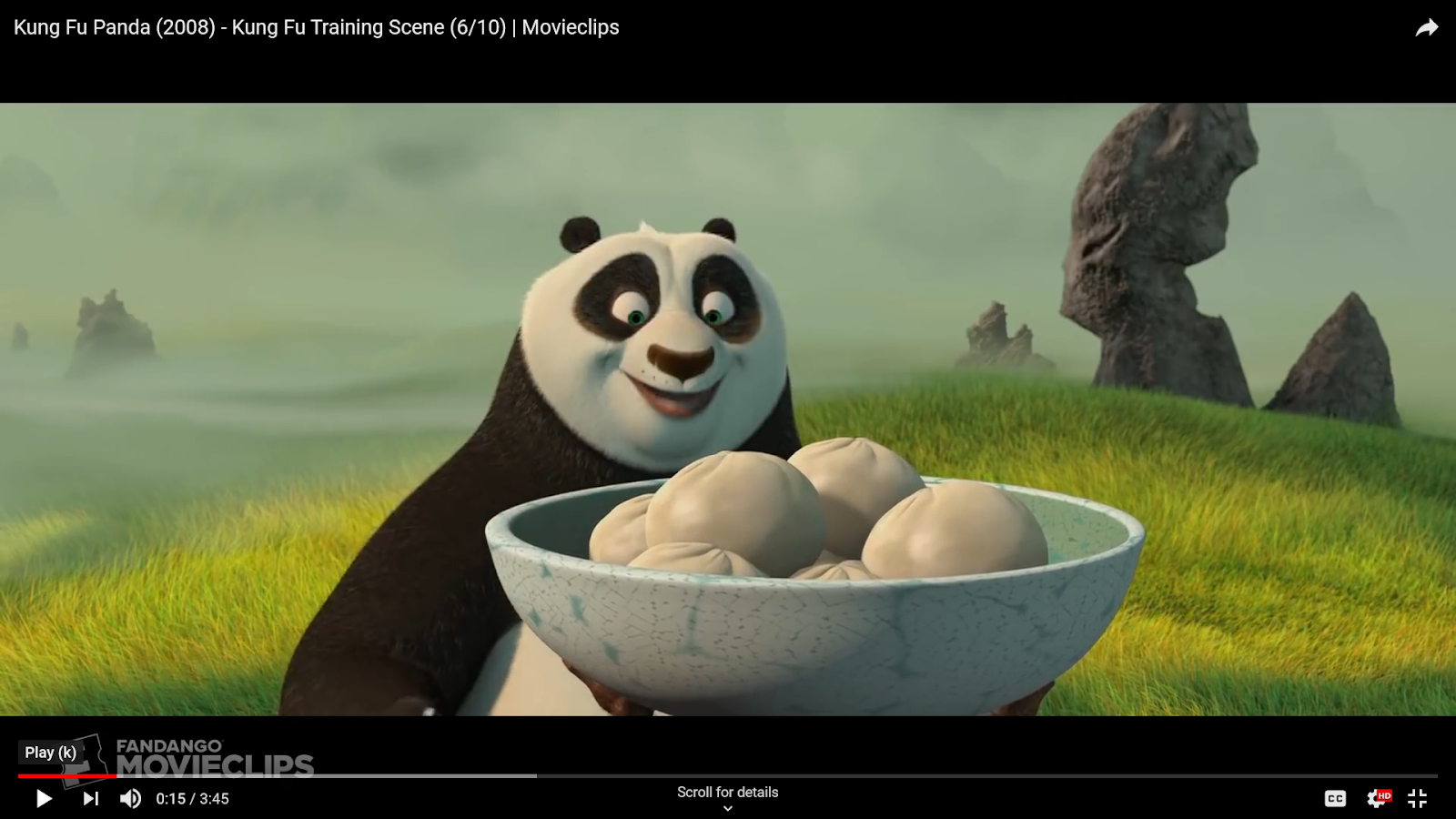
  Today we worked on understanding shots and scenes from films/animations/ advertising, this allows us to understand what's shots are being used. The first task was to take a short scene from a chosen piece, and describe what is happening, the type of shot being used and the timing.

  Task 1

Shot 1: Mid shot 0:01
  Camera facing Po, Halfway up, background noted in scene. (Grass and Rocks).


 Shot 2: Over Shoulder Shot - Creeping in  0:05-0:09
    Camera over the shoulder of Po, facing teacher on rock, background angled to teacher. Main focus here being of the food.


Shot 3: Mid-shot 0:15
  Placing food in forefront, Po in background. Talking, food snatched away as Po reaches for it. 


Shot 4: Two Shot/ Profile Shot 0:20
  Both subjects are in side profile view, grass in foreground. Subjects talking, teacher standing on rock to be eye level with Po. Teacher then wanders off with food, taunting Po.


Shot 5: POV Shot 0:24
  Starts with looking up at the branch with teacher on, the moves to sky, and back to teacher. Teacher talking whiles still holding food.


Shot 6: Wide Angle Shot 0:28
  Po is doing sits ups on a tree branch with teacher instructing to the side. A large amount of environment in view, Branch then snaps and Po falls out of shot, Teacher jumps tot eh side and catcher dumplings in bowl.


Shot 7: Following Shot, pushing into a Mid Range Shot 0:34-0:36
  Following teacher as he walks over to Po with food, camera follows behind. Panda gets food, teacher walks off. As Po starts to eat, teacher attacks and Po loses food. The Mid range shot captures actions.


   Task 2

   Following the previous task, the next was to think about a restaurant scene and what camera angles would be used to gain a sense of emotion. We had to look for scenes used form previous films, and incorporate them into our own vision, whiles identifying the shots. My scene involved one of the character's being dragged away.

Restaurant Scene Test

Wednesday, January 15, 2020

From Script to Screen - Main Character Redesign


   Following the previous character design class, I've decided to do some more sketches and redesign the main character Patrick. I know he is friendly, eccentric, a bit proud, slightly bumbly and in the late 50's - early 60's age range. So with these bases, I tried to aim for circles and square types. Also, I wanted to experiment with changing the body proportions and sizes a little. As the new version of Patrick is a  retired Bomb disposal Expert who is now a Janitor, I looked up 1950's to 60's workmen uniforms.

   These designs are much better, and I will probably use one of these to be the person of the main character. On looking over these again, some of these may appear a lot older than the age bracket. So, when moving into the more finalised image, I will have to bring his appearance younger to match his age.


Overalls don't seem to change much though put the years, so it's gonna be a cause of making them unique to the character an the time period.


Add caption

From Script to Screen - Revised Story 4

  After another tutorial today about my story,  it was deemed best to try and keep my environment to one place rather then too many. Also, there needs to be more of a purpose for the retired BDE expert to be at the theatre, so we discussed him being hired at the theatres new janitor. There is still a query into whether the story needs drama teacher, but this will all be figured out more as more elements are added. The dog is a comedy factor/ sidekick, so he is quite energetic and puppy-like.

I feel like we may be coming to an end product for the story, but will more then likely need a few more tweaks.

* BDE means Bomb Disposal Expert.
 ---------------------------------------------------------------------------------

Revised Story 4

Act 1

 - BDE starts working as a new janitor for the local theatre, dog chewing on a toy/ bone in background.
 - BDE waves goodbye to the drama teacher as she leaves. 
 - BDE starts mopping the stage.
 - Stops and looks at the pictures on the walls, one of him and mates in bomb disposal squad/ pulls out picture from wallet of him and bomb disposal team-mates.
 - BDE starts reminiscing about younger days. 
 - Dog stops chewing toy, gets up and starts sniffing around.
 - Dog starts digging though prop box.
 - BDE notices and calls dog over.
 - Dog returns with something in mouth, BDE tries to retrieve item but do resists.
 - Game of tog starts.
 - BDE manages to get object, on closer inspection realises it a unexploded bomb.
 - Dog excitedly jumps jump, trying to get bomb.
 - BDE moves it away but not in time, Dog catches pin in  mouth.
 - Dog stands before BDE with pin in mouth.
 - Dog swallows the pin, seeming pleased with itself.
 - Bomb starts ticking.

Act 2
 - BDE starts to panic, looking and running around.
 - In blind panic, throws bomb to the back of the theatre, readying to run.
 - Dog runs past happily, retrieving the bomb and comes back. 
 - BDE goes to grab bomb but dog runs off, thinking its a game. 
 - In chase, Dog knocks over the water bucket and mop.
 - BDE slips along floor on soapy water/ Legs get tangles in mop.
 - Crashes into Costume box.
 - Dog comes back and pulls BDE from the wreckage, BDE wearing Bomb disposal cap.
 - As BDE sits up, doig then drops bomb into lap.
 - Bomb starts to tick faster. 
 - BDE sees the open hatch to the back of the theatre stage. 
 - BDE runs over and throws bomb down hatch.
 - Tries to shut hatch but wont move, hinge holding it open is stuck.
 - BDE notices heavy sword mounted on the theatre walls, runs over an drags it over. 
 - Uses swords weight to release the mechanism and the hatch shuts. 
 - BDE then runs to hide behind some of the chairs for cover, the dog bounding after him and barking happily.

Act 3

- Nothing happens, confused the BDE peers behind the chair.
 - Drama teacher returns to theatres, notices the messand the BDE cowering behind one of the chairs. 
 - BDE jumps up, telling her about the bomb.
 - Drama teacher laughs, walks towards the hatch and goes down.
 - Returns with the bomb still ticking.
 - Bomb shields away, when ticking stops, opens one eye to see what's going on.
 - Bomb has a little flag out the top with "BOOM"
 - Shocked, the BDE drops to chair.
 - Teacher explains its a prop, and had come back to retrieve it.
 - Both sit in chair laughing.

---------------------------------------------------------------------------------


  Premise
        
  Retired Bomb Disposal Expert takes on a new job as a local theatre janitors, his dog comes across a bomb and chaos ensues in disposing of it.


  The Log Line

  Bill (The retired bomb disposal Expert) starts a new job as a janitor at the local theatre, his sniffer do comes across a bomb. Bill struggles to be rid of the bomb, his trusty companion endeavoring to bring it back, eventually they learn that the bomb was just a prop. 
   

From Script to Screen - Revised Story 3


  In this revision, I thought about adding a little more chaos but making the hatch stuck in place so it wont shut. The BDE would have to find a way to get the mechanism to release. So, instead of cutting the wires of the bomb with the sword, if it was a heavy broad sword it would give enough force to break the hatch and it would then shut. Maybe using the sword to keep the hatch shut, so when the bomb explodes, the doors won't swing open. 


Soundscape experiment


  Using the sound records provided by the university, the task today was to capture sounds to mix in Adobe Audition and make a new sound.

Below is the sound created by 4 separate bytes.


Tuesday, January 14, 2020

Character Design Lesson 1 - Basics

   
    Today, we started learning the basics of character design. Firstly, before creating the characters we want, we have to ask ourselves some questions. These questions will determine a little more about the appearance of the character, and how their clothing will fit with them. These questions are as follows: 
                                 Who, What, When Where, Why and How? 

  Once we know their back story and personalities, we have to start thinking about the archetype that they fit. All of the types below are the main narrative characters used in stories. 

Hero's are what the audience mainly focus on, they can be flawed or coming to terms with something. Hero types are often more humanoid, this make them more relatable to the viewer.

The sidekick, very often they are used for bringing the humor to a overbearing situation. Most sidekicks are varied in shape, and can be animal or humanoid.

Villain's are well known for their menencing goals, and like sidekicks can vary in appearance. They will always be the opposite of the hero. not only in personality but in goals. Villains will have sharper appearances then hero's or sidekicks.

Mentors are not a main focus of the story, they will be in the back ground guiding the hero along their path. A stereotypical mentor is often a older character with greying hair/ beard. 

The Love Interest character, although dying out in a lot of genre, these are normally the characters the main protagonist will set out to save. Love interest archetypes are not often interesting, and again are more of a sidekick.

Tricksters can be both heroic and villainous. Mostly self absorbed, they will set out on a journey with themselves in mind, and may become redeemed in some way. 


After learning about the the importance of knowing our characters archetypes, we were introduced to the main styles of character drawing.

Iconic - Simple basic geometry, very limited expression and anatomy. This style is not easy for animating, more for advertising.
                            E.G - Powerpuff girls, Hello Kitty and early Mickey Mouse.

Basic - Stylized (normally 1950' - 60's cartoons), has limited anatomy and a more varied range of expression.  Their characters are often silhouetted, smooth and uncluttered. 
                             E.G - Dexter's Lab, Kim Possible, Ren and Stimpy.

Broad - More exaggerated, has better anatomy and expression bases. There is often a higher amount of detail, having more joints for smoother actions. 
                                   E.G - Garfield, Tom and Jerry, Simpsons.

Comic Relief - A lot more attention to detail, very stylized and a lot of anatomy.

Lead Characters - Coming up to a massive amount of anatomy, and can be more animal-like while containing more realism. This is normally the highest level of design used in animation, more than this makes the character too complex.

Realistic - Illustrational, complex, normally used for computer games/ production art rather than animating. 


  Following these examples, we was each given an animated characters and asked to change the stylisation of it. If it was realistic, we was to think about how to make it more simplistic or iconic. I received Homer Simpson as my character. I felt the Homer was in about the broad spectrum, so I decided to go more towards lead/ realism. We also had to think about keeping the character true to its original persona (so its recognisable), and understand its proportions. 

Homer Simpson

Lead/ Realism
 When I first drew him, I missed his character a bit with the eyes and smile. They was much too knowing and focused, so with some guidance I changed them to give him more of his iconic vacantness.


The lesson then moved onto the importance of shape. Shape can portray what part a character has to play in a story.

Circles - Often used for softer, friendlier types. Circles can represent safety, youth and feminine aspects.

Squares - Strong, powerful, stable, normally used for musculare characters or boss monsters.

Triangles - Can be menacing and mysterious, normally giving a sense of danger. Triangles are used for villains, but not all villains are out to harm. Some just bring ill-intent to what is most important to the main character.

ArcheTypes - Have one shape but their personalities being opposite.
                                                          E.g -  Lotso from Toy Story 3.


  With this new knowledge, the next task was involving taking a character we like (you can use the one previous if wanted) and changing them slightly to a new shape. However, we had to keep to the previous style chosen. Homer is more circular, giving him his appearance to fit his bumbling nature. I decided to go for more triangulare, but also a little bit of square. We was allowed to change some aspect, like brows for examples. This new styles gives homer a more menacing and focused appeal.

Homer Re-shaped (Squares/Triangles)
Now we had fun creating the new style of our given characters, it was our chance to make a line up of characters using these shapes. We was to think bout their personalities and experiment more with style. I got given the category Ninjas.

Ninjas 1

Ninjas 2

I seem to use the same shape over and over again, this may be a little subconscious. But, I'm hoping with enough practise, this is something that will change. It's also important to think about clothing, weapons/ items and any injuries that may add to the character.


Monday, January 13, 2020

From Script to Screen - Theatre Sketches


  As my main setting is a theatre, I decided to do some very quick sketches of the inside and outside of small local theatres. These are mainly based in London, and the sketches are quick loose so to get a idea of the environment more. Once I have established the type of theatre desired, more in depth concept and production art will be made.

      Theatre Internal Sketches


This one maybe a mixture of theatres.


  Theatre External Sketches


From Script to Screen - Revised Story 2 and Thinking About Camera Angles


 I have carried on with my previous story line (changing one or two bits), and have thought about the possible camera angles to get the most impact. These are just rough and are open to change (Angle sin red).


Major - Submission Post: Final Animation, Reflective Statement and Links

Final Reflective Statement When starting the Major Project, there was still quite a lot of work left over from Minor for the planned final...